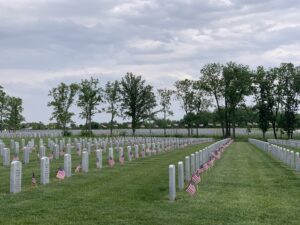
 Once again the nation has paused to honor those who have secured and guaranteed the freedoms we use and unfortunately sometime abuse. I have repurposed an article I originally wrote in 2013 about 3 local farmers as we celebrate Memorial Day on the year of our 250th year of Independence. The farmers featured have now all passed away. I am glad I had the opportunity to get to know each of them personally. They were outstanding Americans in many ways.
Many years have passed since World War II and the construction of the Elwood and Kankakee ordnance plants that displaced many family farms. As time passes, firsthand accounts of this time in history become more difficult to obtain.
The Will County Farm Bureau recently conducted three taped interviews that provide a firsthand account of life on a farm during the last 75 years. In these interviews were accounts of the great depression and World War II. Tom McCoy, Bob Fitzer, Lester and Rita Robbins provided first hand accounts of a combined 220 years of agricultural history. Some items of interest from long ago follow:
Lester Robbins lived south of Manhattan within sight of the Joliet arsenal. For two years he worked an afternoon shift to help build the federal arsenal. He managed to maintain the farms crops and livestock until the construction was completed. He returned to full-time farming after the plant became active. The expected birth of his first child prevented him from being drafted into the service.
Tom McCoy of Shorewood, grew up and started farming in what is now known as Romeoville. He did not want to fight but felt he had to enlist out of duty for the country. He passed his test for a special Navy program. As he finished with some paperwork the recruiters discovered he was a farmer and told him he had to pack his bags and go back home.
During the war, many farmers were given agricultural deferments on the premise they were more valuable producing food, than serving as a soldier. Many other jobs were considered essential to the success of the war effort and given similar deferments.
Bob Fitzer was married and farming west of Joliet during the war. He remembers that he had twice as many points as necessary to be granted an agriculture deferment. However, in 1945 he was told to report to Chicago for a physical and was going to have to serve. He had passed his physical and was waiting for his call-up when the Japanese surrendered to end the war.
Bob Fitzer graduated from High school on June 4th, 1942. Many high school students worked at the Joliet arsenal at night while attending school. Fate intervened for some of those students when they had to miss work to attend their graduation ceremony. An explosion the night of graduation killed many workers. Bob had many classmates that were not working that night so they could attend their high school graduation.
There is a memorial just as you enter the cemetery that honors those who died from two separate explosions at the munitions plant during the war. It seems fitting to recognize their sacrifice on the same ground where they worked and died and among some of the soldiers who relied on their efforts.

0 Comments