In 2005 I traveled to New Zealand as a participant in the Illinois Farm Bureau’s market study Program. New Zealand agriculture had previously become heavily subsidized. In the 1980’s they transitioned away from government support. Earlier today I found a small notebook with my notes from the trip. Here are some highlights. Sorry, if they may mean more to me than you.
Some comments were: “The government could not afford to support the subsidies; they were consuming too much of the GDP.” “The change was too slow; the slower the transition the more painful it is.” “Change is scary, but competition makes me better.” “If I get complacent on my farm, I will fail.” “Government subsidies encouraged skinny sheep; we farmed for quantity to get more payment and not for quality.”
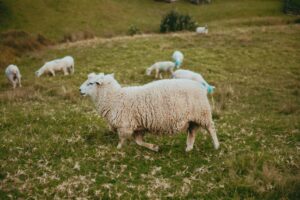 I visited a sheep farm with 30,000 sheep and 9 staff with 4 shepherds. They were sorting sheep; they are penalized for sheep over 190 pounds. Horses are better than ATV’s for accessing tough terrain. You are not sore at night after 8 hours in a saddle, but very sore the next day. Final goal is 50,000 sheep/year marketed. I visited another sheep farm where Lord of the Rings was filmed. They had removed most of the hobbit village set before the owner realized he could turn the few remaining hobbit homes into a tourist attraction.
I saw many wind turbines; the country is non-nuclear for energy. They are not afraid of GMO, but adoption is slow since Europe is a major export market.
I visited a tree farm where the owner was a fan of Aldo Leopolds’ book, Sand County Almanac. He grew Radiata Pine and Eucalyptus. He paid $.20 per tree and it cost $.20 each to plant. It was 1000 hectares, and the first 10-20 years they de-limb the trees to 6-12 meters tall. Our bus got stuck in the sand and we had to push it out.
The rare grain farmer we visited grew wheat, not for livestock feed but for dog biscuit production. Sheep dogs were valuable assets. He quit raising deer in 2002 and was experimenting with zebu. They used ryegrass and radishes for grazing. I visited an organic apple farm that grew Braeburn and Royal Gala. They sold 120,000 cases of apples and juice to Whole Foods. Their marketing strategy used a picture of the farmer on packaging. He used wind machines to aid pollination on calm days. The dairy farmer and apple producer both claimed adequate labor was their biggest issue.
I ate cold lamb-burgers since that was how they served them. I had to take part in the national census one morning in our hotel, watched a sheep get sheared in less than a minute and saw a real Kiwi bird. I spent one night lodging at a dairy farm that the Queen of England had once visited to purchase dairy stock for her herd in England.
Other quotes that I randomly wrote were: “If you have to get trust with a piece of paper, you never had it to begin with.” “In your country they pay people to be poor; how is that beneficial?” “The change from government subsidies was harder on the small towns and the suppliers than the farmers; our suppliers had become fat cats at the farmer’s expense.” “The Canadian Dairy Industry is like an inflating balloon getting bigger and bigger; Someday the politicians are going to pop it.” “Since nobody gives me anything, they cannot take it away.”
In summary, the country has more sheep than humans, but the ratio is shrinking. In many places milk cows were replacing sheep; 96% of milk produced was exported, much of it as dehydrated milk powder to reduce bulk and increase shelf life. On my final full day, I witnessed the sun rise over the Pacific Ocean in the town of Napier, it felt like a tiny sliver of paradise. We were given some time to be tourist, and I rented a bicycle and ate my first and only mincemeat pie.
Should I visit again? I do not have in my notes if the water swirled the opposite direction when flushing a toilet. I am not sure if that is reason enough to endure that 17-hour flight again.
0 Comments